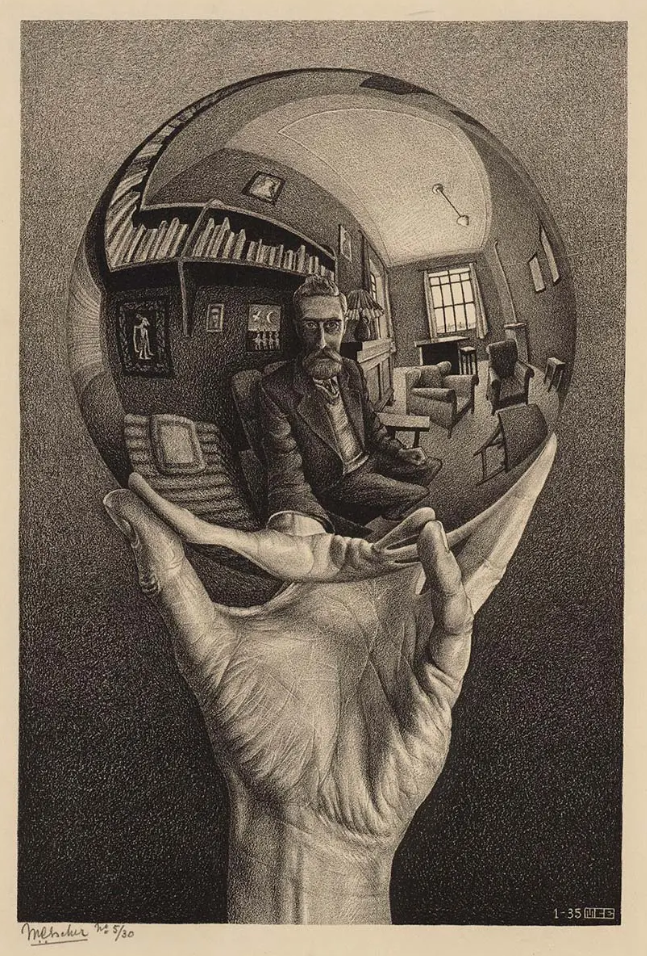
Hand with Reflecting Sphere is a 1935 lithograph by Dutch artist M.C. Escher. It depicts Escher's own hand holding a mirrored glass sphere, within which the entire room and the artist himself are reflected. The work demonstrates how a convex reflective surface compresses a wide field of view into a single image.
Hand with Reflecting Sphere by M.C. Escher
Before continuing, please take a moment to really look at the work.
Quick Facts About Hand with Reflecting Sphere
Year: 1935
Medium: Lithograph
Dimensions: 21.3 × 28.2 cm (8.4 × 11.1 in)
Current location: Escher in The Palace Museum, The Hague, Netherlands
Artistic period: Italian period / early exploration of perspective
Core concept: Spherical self-reflection and wide-angle optical compression
What Is Happening in Hand with Reflecting Sphere?
The lithograph shows a human hand — Escher's own left hand — extending toward the viewer and cradling a polished, reflective sphere. In the surface of the sphere, a miniaturized reflection of Escher himself is visible at the center, seated in a room. The surrounding walls, windows, and furnishings of the room curve around him within the sphere's surface.
Because the reflection is convex, it captures nearly 180 degrees of the room in a single curved image. The hand holding the sphere is also reflected within it, creating a self-enclosed loop: the hand appears both inside and outside the sphere simultaneously. No element of the image is spatially impossible, but the effect produces a strong sense of recursive visual layering.
What Are The Themes And Interpretation of Hand with Reflecting Sphere?
Hand with Reflecting Sphere is widely interpreted as an exploration of self-reference and the impossibility of a truly objective viewpoint. The artist is inescapably present in his own image, his reflection is fixed at the center of the sphere no matter how the sphere is rotated. This has been associated with philosophical ideas about the observer's role in shaping perception.
The work also engages the theme of infinity through visual recursion. The reflection contains a reflection, which in principle contains another, without a defined stopping point. This anticipates themes Escher would develop more explicitly in later prints such as Drawing Hands (1948), where two hands draw each other into existence, and Print Gallery (1956), which constructs an image containing itself.
Self-portraiture is another documented dimension of the work. Rather than painting himself in a conventional mirror, Escher chose a sphere, a form that compresses and distorts the surrounding world while keeping the self at its center. This choice emphasizes the subjectivity inherent in any act of self-representation.

Drawing Hands (1948)
Historical Context of Hand with Reflecting Sphere
Escher made Hand with Reflecting Sphere during his years in Rome, a period characterized by close observation of architecture, light, and spatial phenomena. He had not yet begun his intensive engagement with mathematical tessellations, which would define his later career. The 1935 work belongs to an earlier phase in which his primary concerns were optical precision and perspective.
The lithograph is not part of a formal series, but it connects directly to Escher's sustained interest in mirrors and reflective surfaces. He returned to similar ideas in Still Life with Spherical Mirror (1934) and Three Spheres II (1946), both of which use reflective spheres as devices for spatial compression and self-inclusion. Across these works, the sphere functions as a recurring instrument for questioning how space is represented.
The mathematical community later recognized the image's relevance to concepts such as inversion geometry, where points inside and outside a sphere are mapped onto each other. Douglas Hofstadter cited Escher's work, including reflective self-reference of this kind, as an illustration of strange loops in his 1979 book Gödel, Escher, Bach.
Why Hand with Reflecting Sphere matters
Hand with Reflecting Sphere is among the most reproduced images in Escher's catalog and one of the most widely recognized self-portraits in twentieth-century graphic art. Its combination of technical draftsmanship and conceptual clarity made it accessible to audiences outside the fine art world, including mathematicians, cognitive scientists, and designers.
The image has been used in academic contexts to illustrate concepts in optics, epistemology, and the philosophy of perception. Its structural self-reference, an image that contains itself, gave it particular relevance to fields concerned with recursion, feedback, and self-similar systems. This cross-disciplinary reach helped establish Escher as a figure relevant beyond the visual arts.
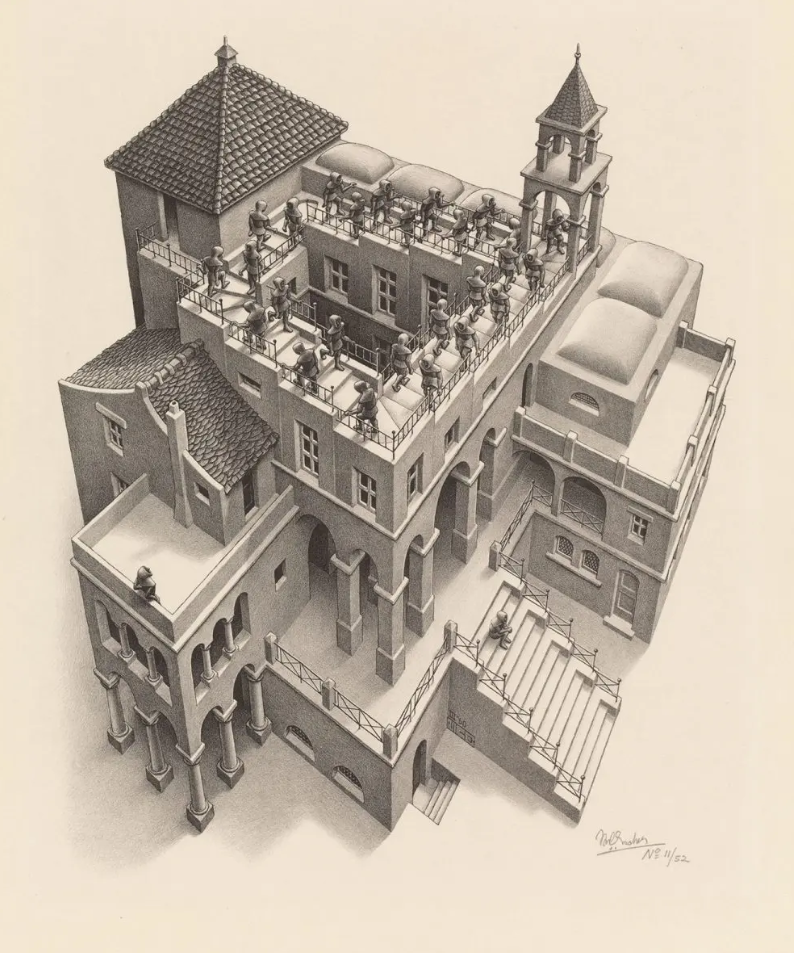
Within Escher's own body of work, the lithograph represents an early articulation of ideas he would develop throughout his career. The compulsion to place the self at the center of an infinite regress, visible here in straightforward optical terms, later became the engine of far more elaborate compositions such as Relativity (1953) and Ascending and Descending (1960).
Ascending and Descending (1960)
Frequently Asked Questions About Hand with Reflecting Sphere
What Is the Meaning of Hand with Reflecting Sphere?
The work is most commonly interpreted as a statement about the inescapability of the self in perception. The artist's reflection remains centered in the sphere regardless of orientation, suggesting that observation always carries the observer's perspective with it. It also demonstrates the optical principles of convex reflection without distortion or invention.
How Did Escher Create Hand with Reflecting Sphere?
Escher worked from direct observation, holding a mirrored glass sphere and studying its reflection before rendering it as a lithograph. Lithography involves drawing on a flat stone or plate with a greasy medium, then using that surface to print the image on paper. The tonal range in the sphere's surface, from bright highlight to deep shadow, was achieved through careful gradation during the drawing process.
Where Is Hand with Reflecting Sphere Located Today?
The original lithograph is held in the collection of the Escher in The Palace Museum in The Hague, Netherlands. The museum houses the largest institutional collection of Escher's work. Limited-edition prints and reproductions are held in various private and institutional collections worldwide.
Why Is Hand with Reflecting Sphere Important?
The work is significant as both an optical study and an early example of self-referential art in the modern tradition. It anticipated themes, recursion, infinite regress, observer-dependent perspective, that became central to Escher's mature output. Its clarity and precision made it a key reference point for mathematicians and philosophers engaging with visual representations of self-reference.
If you like Hand with Reflecting Sphere, you may also like…

Eye (1946)
Reptiles (1943)
Sky and Water I (1938)