Belvedere by M.C. Escher
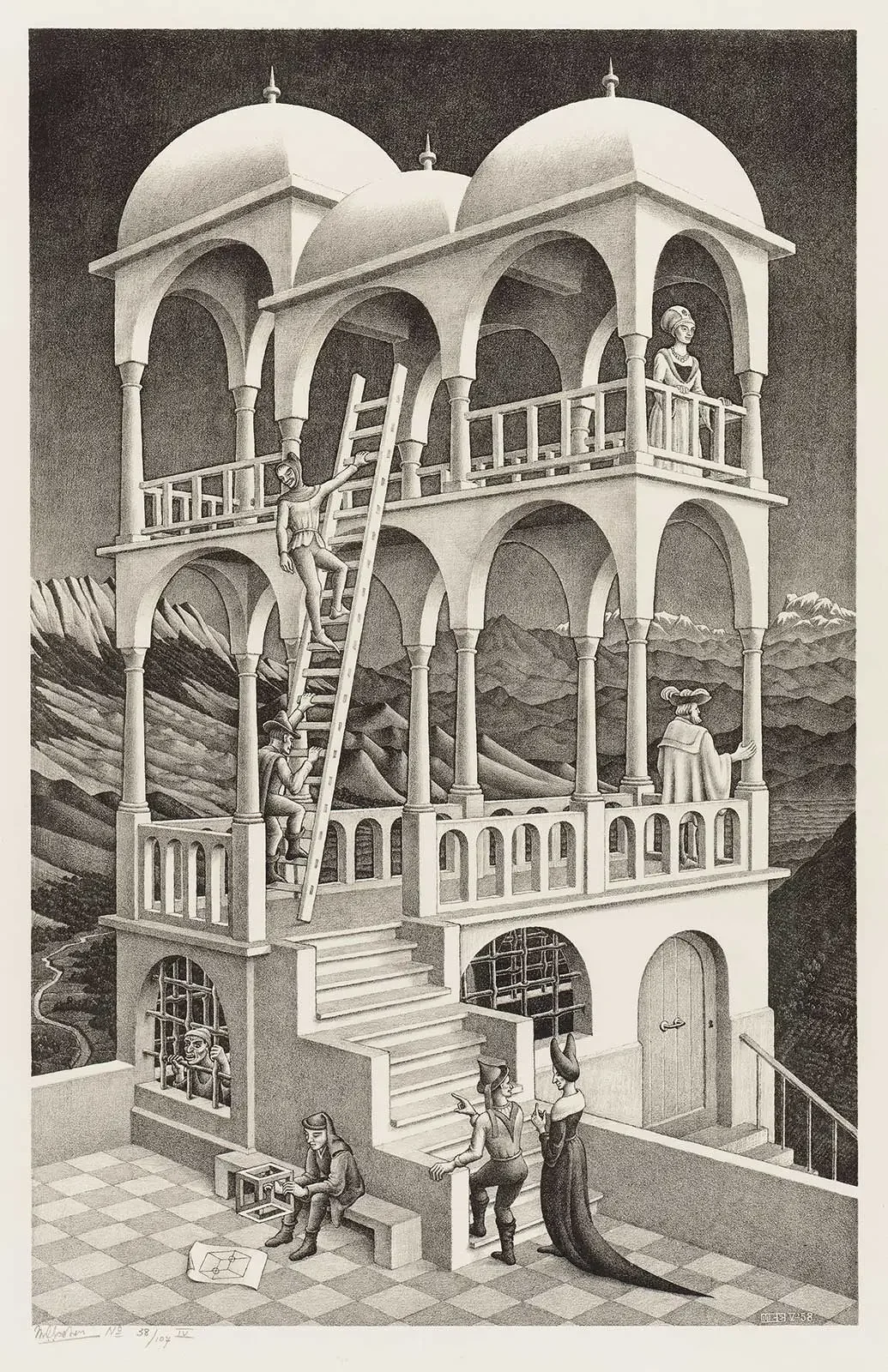
Belvedere is a 1958 lithograph by Dutch artist M.C. Escher. The print depicts a three-story architectural structure in which columns connect the upper and lower floors in geometrically impossible ways.
The building appears structurally coherent from any single viewpoint but violates the laws of three-dimensional space when examined as a whole.
Before continuing, please take a moment to really look at the work.
Quick Facts About Belvedere
Year: 1958
Medium: Lithograph
Dimensions: 46.2 × 29.5 cm (18.2 × 11.6 in)
Current location: Escher in The Palace Museum, The Hague, Netherlands
Artistic period: Mature period of impossible constructions
Core concept: Impossible architectural structure based on the impossible cube
What Is Happening in Belvedere?
The lithograph shows a two-story stone pavilion with arched openings and classical columns. A seated figure on the ground floor holds a small cubic object and studies it. Several other figures occupy the structure: one looks out from the upper level, another climbs a ladder leaning against the exterior. Mountains and a distant landscape are visible in the background.
The architecture appears stable at first glance, but the columns connecting the two floors occupy impossible positions. Pillars that seem to support the upper story from the front actually connect to the back of the lower floor. The crossbeams and supports twist through space in ways that cannot exist in three dimensions. A figure on the upper level looks down at the ground, but the structural elements between them follow conflicting spatial logics.
At the bottom of the image, lying on the ground near the seated figure, is a geometric object that resembles the impossible cube. This object serves as the conceptual blueprint for the building's construction. The figure holding the cube appears to contemplate it, suggesting awareness of the structural paradox.
How Belvedere Works
The lithograph shows a two-story stone pavilion with arched openings and classical columns. A seated figure on the ground floor holds a small cubic object and studies it. Several other figures occupy the structure; one looks out from the upper level, and another climbs a ladder leaning against the exterior. Mountains and a distant landscape are visible in the background.
The architecture appears stable at first glance, but the columns connecting the two floors occupy impossible positions. Pillars that seem to support the upper story from the front actually connect to the back of the lower floor. The crossbeams and supports twist through space in ways that cannot exist in three dimensions. A figure on the upper level looks down at the ground, but the structural elements between them follow conflicting spatial logics.
At the bottom of the image, lying on the ground near the seated figure, is a geometric object that resembles the impossible cube. This object serves as the conceptual blueprint for the building's construction. The figure holding the cube appears to contemplate it, suggesting awareness of the structural paradox.
What Are The Themes And Interpretation of Belvedere?
Belvedere explores the limits of visual representation and the conflict between local and global coherence. Each part of the building makes sense individually, but the whole cannot be reconciled. This has been interpreted as a commentary on the gap between perception and reality, where immediate sensory data can seem reliable while concealing deeper contradictions.
The presence of human figures within the impossible structure adds a layer of absurdity. The seated man contemplates the impossible cube as though solving a puzzle, while others occupy the building as if it were functional. This contrast between intellectual recognition and unquestioning inhabitation suggests themes of awareness versus ignorance. The figures inside the paradox are unbothered by it.
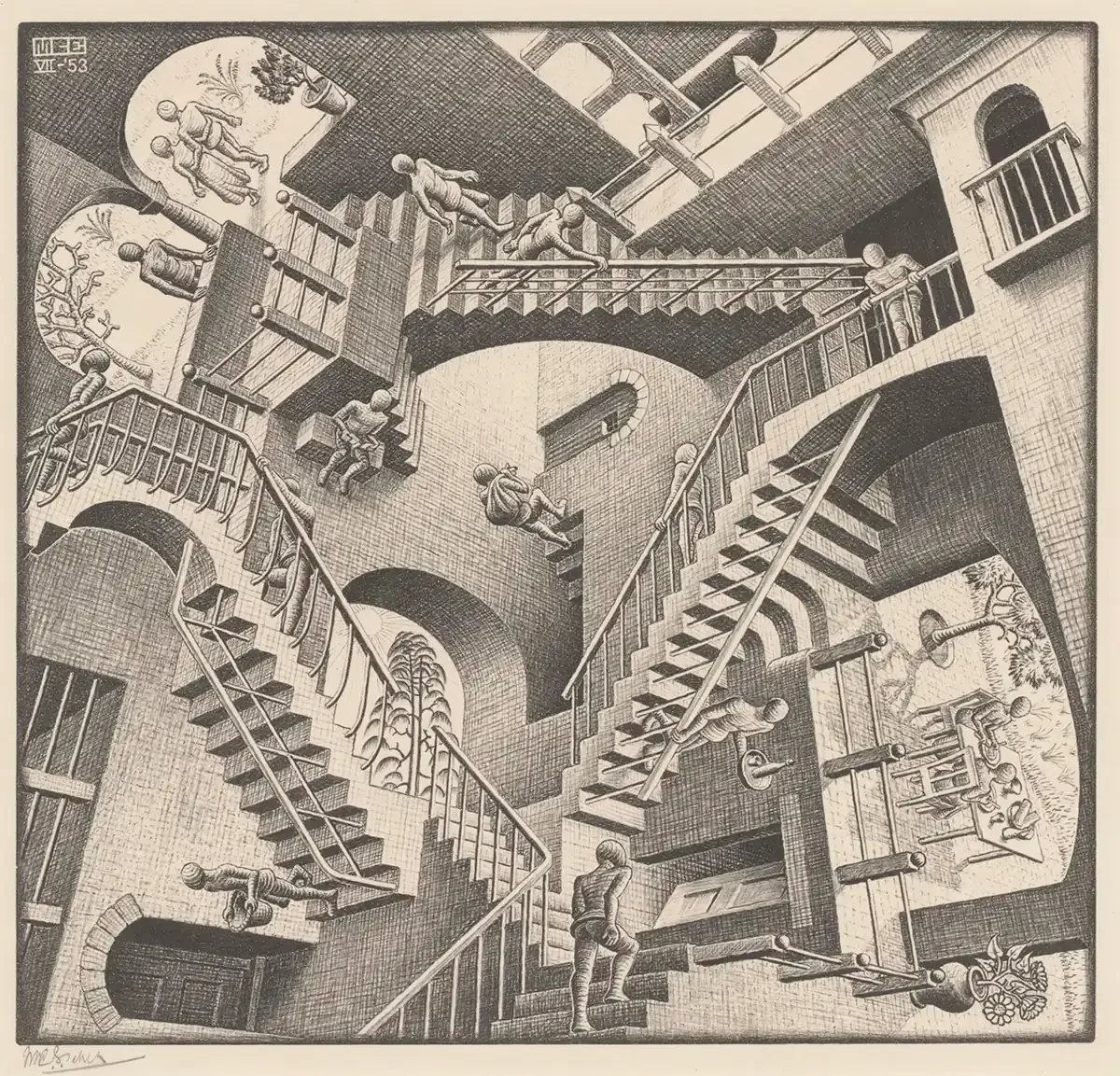
The work also engages with architectural fantasy and the tradition of imaginary buildings in art. Renaissance artists such as Piranesi created elaborate architectural visions that bent the rules of structure and gravity. Escher extended this tradition into the realm of pure logical impossibility, where the failure is not physical but geometric. The classical architectural style, arches, columns, and stone masonry give the structure an air of ancient authority, which contrasts with its fundamental incoherence. It is similar to art works like Print Gallery (1956) and Relativity (1953).
Relativity (1953)
Historical Context of Belvedere?
Escher created Belvedere during the late 1950s, a period in which he was deeply engaged with impossible objects and paradoxical constructions. He had been introduced to the work of mathematician Roger Penrose, whose impossible triangle and staircase provided structural models for visual paradoxes. Belvedere applies similar principles to a fully realized architectural setting rather than an isolated geometric figure.
The lithograph belongs to a cluster of works from this period that depict impossible spaces, including Ascending and Descending (1960), in which figures endlessly climb a looped staircase, and Waterfall (1961), where water flows perpetually uphill. All three prints use architectural settings to naturalize the impossible, embedding paradoxes in recognizable environments rather than abstract diagrams.
Escher's choice of a classical pavilion reflects his long-standing interest in Mediterranean architecture. He had spent years traveling and sketching in Italy during the 1920s and 1930s, and many of his later impossible constructions echo the stone buildings, arches, and courtyards he observed during that period. Belvedere combines this architectural vocabulary with mathematical concepts developed decades later.
Why Belvedere Matters
Belvedere is one of Escher's most referenced works in discussions of impossible objects and visual paradox. Its architectural complexity makes it a more elaborate example of the impossible cube than earlier schematic versions. The lithograph demonstrates how impossible geometry can be embedded in richly detailed, naturalistic imagery without losing its paradoxical character.
The work has been used extensively in cognitive science and psychology to study how the brain processes conflicting spatial information. Researchers have analyzed how viewers initially accept the structure as plausible before recognizing its impossibility. This process of delayed recognition has made Belvedere a standard reference in studies of visual perception and spatial reasoning.
Within Escher's body of work, Belvedere represents a mature synthesis of his technical skill and conceptual interests. The lithograph combines precise draftsmanship, atmospheric perspective, and human narrative with a rigorous geometric paradox. It avoids the purely decorative quality of some tessellations and the overly schematic quality of purely mathematical diagrams, instead integrating impossibility into a fully inhabited world.

Belvedere is similar to Waterfall (1961)
Frequently Asked Questions About Belvedere
What Is the Meaning of Belvedere?
Belvedere is most commonly interpreted as an exploration of the gap between local coherence and global impossibility. The structure appears functional in any isolated section, but cannot exist as a unified whole. The seated figure contemplating the impossible cube suggests that intellectual awareness of paradox does not prevent it from appearing real. The work demonstrates how perception can be simultaneously convincing and contradictory.
How Did Escher Create Belvedere?
Escher began with the concept of the impossible cube, a geometric figure that cannot exist in three dimensions. He then designed an architectural structure in which the columns and supports follow the same impossible connectivity as the cube's edges. The lithograph was created by drawing on a stone or plate with greasy crayon, then transferring the image to paper through pressure. Escher used careful shading and perspective to make each local element appear structurally sound.
Where Is Belvedere Located Today?
The original lithograph is held in the Escher in The Palace Museum in The Hague, Netherlands. The museum houses the most comprehensive collection of Escher's prints, drawings, and preparatory studies. Limited-edition prints and reproductions of Belvedere are held in museums and private collections worldwide due to the work's popularity.
Why Is Belvedere Important?
Belvedere is significant as a fully developed architectural application of impossible geometry. It extends the impossible cube from a simple diagram into a complex, inhabited structure. The work has been influential in cognitive science, architecture, and popular culture as a demonstration of how paradoxes can be rendered convincingly. It represents a key example of Escher's mature period and his ability to integrate mathematical concepts into narrative imagery.