Eye by M.C. Escher
Eye is a 1946 mezzotint by Dutch artist M.C. Escher. The print depicts a close-up of a human eye with a human skull reflected in its pupil. The work combines anatomical precision with memento mori symbolism, creating a direct visual confrontation between life and death within the mirror of the eye itself.

Before continuing, please take a moment to really look at the work.
Quick Facts About Eye
Year: 1946
Medium: Mezzotint
Dimensions: 15 × 20 cm (5.9 × 7.9 in)
Current location: Escher in The Palace Museum, The Hague, Netherlands
Artistic period: Post-war transitional period
Core concept: Reflection of death in the organ of sight
What Is Happening in Eye?
The mezzotint shows a highly detailed human eye filling most of the frame. The eye is rendered with precise anatomical structure: eyelashes, iris texture, and the subtle reflections across the corneal surface are all visible. In the black pupil at the center of the eye, a human skull is reflected as though the eye were a curved mirror.
The skull appears upright and faces the viewer directly. It is positioned as a clear reflection rather than an ambiguous shape, making the symbolic content immediately readable. The surrounding eye tissue, the iris, sclera, and eyelid, is rendered with tonal gradations that create a three-dimensional appearance. The contrast between the soft organic textures of the living eye and the stark geometry of the skull is visually sharp.
What Are The Themes And Interpretation of Eye?
Eye is widely interpreted as a memento mori — a reminder of death. The presence of the skull in the pupil suggests that death is inseparable from vision and, by extension, from consciousness. The work literalizes the idea that mortality is reflected in all human perception, a theme common in European vanitas imagery dating back to the Renaissance.
The choice of the eye as the site of this reflection carries philosophical weight. The eye is traditionally associated with knowledge, observation, and the act of seeing truth. By embedding a death symbol directly in the organ of sight, Escher suggests that awareness of mortality is foundational to vision itself. This aligns with existentialist ideas circulating in post-war Europe during the 1940s.
Self-awareness is another documented layer of interpretation. The reflection in the eye could represent the self looking back at itself and recognizing its own finitude. This theme connects Eye to other works by Escher that involve mirrors, reflections, and recursive seeing, including Hand with Reflecting Sphere (1935) and Still Life with Reflecting Sphere (1934).
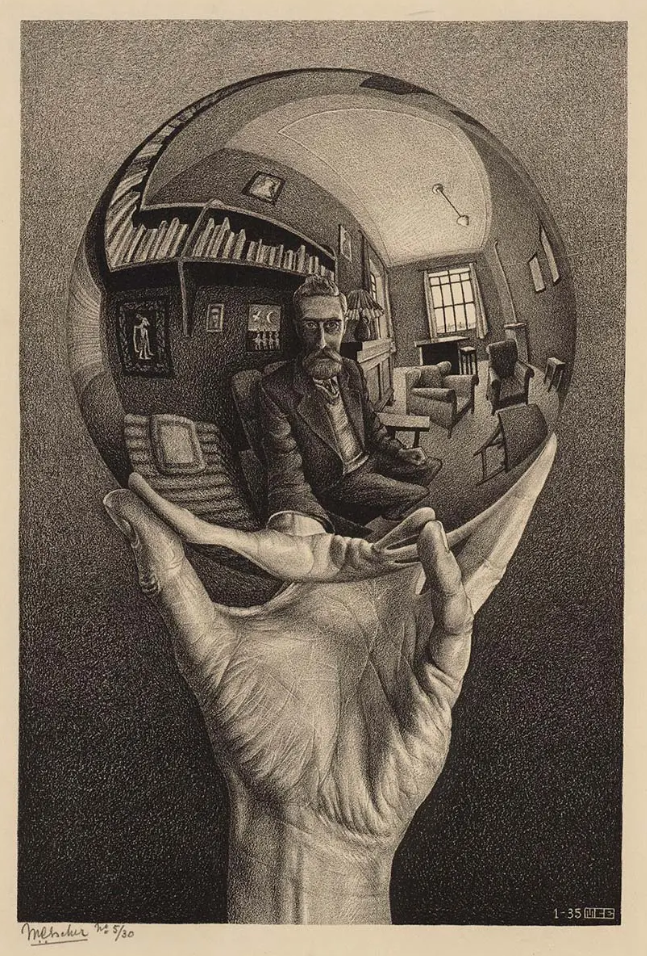
Hand with Reflecting Sphere (1935)
Historical Context of Eye?
Escher created Eye in 1946, shortly after the end of World War II. He had spent the war years in the Netherlands under German occupation, a period that influenced his choice of darker, more introspective subject matter. The skull motif, while not new to European art, carried particular resonance in the immediate aftermath of mass death and destruction.
The mezzotint medium was one Escher used sparingly but with notable results. Mezzotint produces rich blacks and subtle tonal gradations, making it well-suited to rendering both the organic texture of the eye and the hard contours of the skull. Escher completed only a small number of mezzotints, with Eye standing as one of the most technically refined examples.
The work does not belong to a formal series, but it shares thematic connections with other Escher prints that use eyes as symbolic or structural elements. In works like Reptiles (1943) and the later Eye (1958 wood engraving), the eye functions as a point of observation or self-reference. The 1946 Eye is more explicitly symbolic than most of Escher's later work, which tended toward spatial and mathematical puzzles rather than allegorical content.
Why Eye Matters
Eye is significant as an example of Escher engaging with traditional symbolic content rather than purely formal or mathematical concerns. While much of his later fame rests on impossible constructions and tessellations, Eye demonstrates his ability to work within established iconographic traditions and produce images of conceptual weight.
The technical execution of the mezzotint contributed to its lasting impact. The depth and precision with which Escher rendered both anatomical detail and reflective illusion established the work as a reference point for printmakers interested in combining symbolic content with technical mastery. The image has been reproduced widely in contexts ranging from medical illustration to philosophical texts on perception.
Within Escher's career, Eye represents a transitional moment between his earlier landscape and architectural studies and his later explorations of tessellation and impossible geometry. It retains a connection to symbolic realism while anticipating his growing interest in paradox and visual recursion. The work's directness, its refusal to obscure its meaning, makes it an outlier in a body of work often praised for ambiguity, with iconic prints like Relativity.
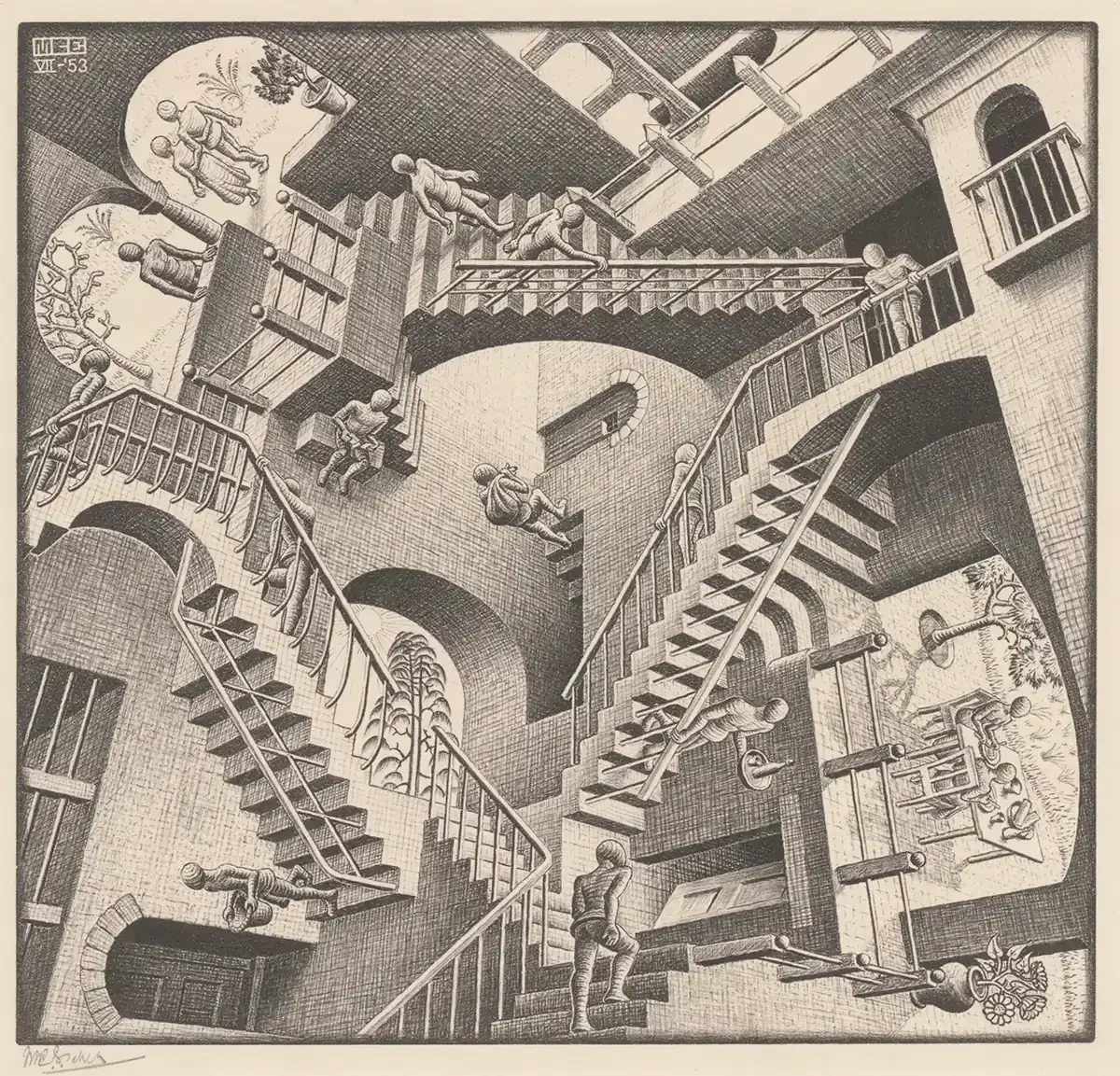
Relativity (1953)
Frequently Asked Questions About Hand with Reflecting Sphere
What Is the Meaning of Eye?
The work is most commonly interpreted as a memento mori, a reminder that death is always present in human consciousness. The skull reflected in the pupil suggests that mortality is inseparable from the act of seeing and, by extension, from being aware. Some interpretations emphasize self-reflection, with the eye seeing its own end.
How Did Escher Create Eye?
Escher used the mezzotint printmaking technique, which involves roughening a metal plate to hold ink, then smoothing specific areas to create lighter tones. The process allows for exceptionally fine gradations of tone, which Escher used to render the soft textures of the eye and the hard geometry of the skull. The plate was inked and pressed onto paper to produce the final print.
Where Is Eye Located Today?
The original mezzotint is held in the collection of the Escher in The Palace Museum in The Hague, Netherlands. The museum maintains the largest institutional archive of Escher's prints, drawings, and preparatory studies. Limited-edition prints from the original plate are held in various collections worldwide.
Why Is Eye Important?
Eye is significant as a rare example of Escher working with explicit symbolic content rather than spatial puzzles or mathematical structures. It demonstrates his technical mastery of mezzotint and his engagement with traditional memento mori themes. The work also connects to his broader interest in reflection, self-reference, and the role of the observer in constructing meaning.
If you like Hand with Reflecting Sphere, you may also like…

Hand with Reflecting Sphere (1935)
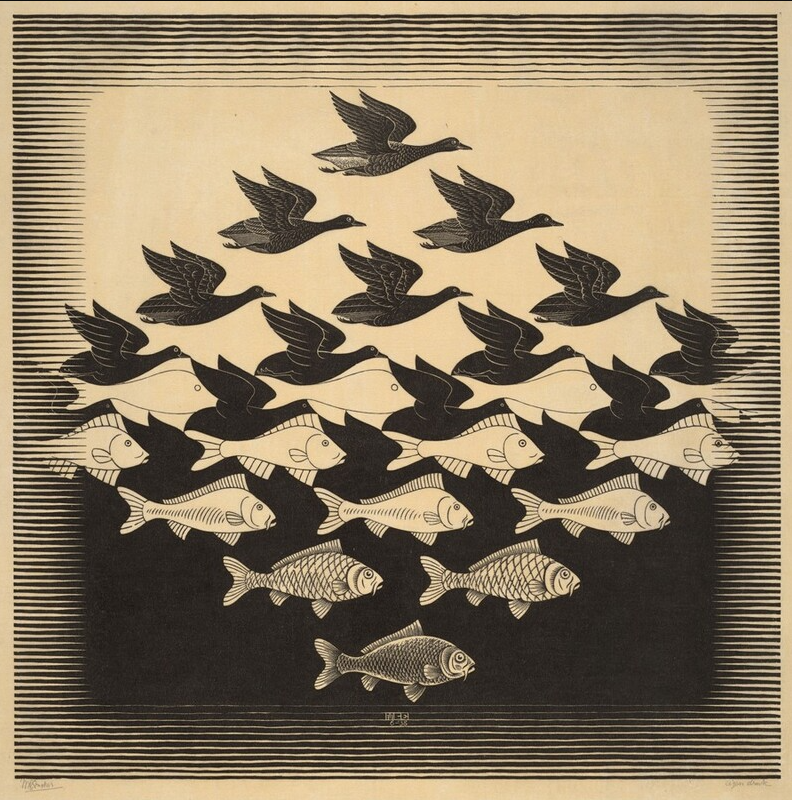
Sky and Water I (1938)