Convex and Concave by M.C. Escher
Convex and Concave is a 1955 lithograph by Dutch artist M.C. Escher. The print depicts an architectural structure that appears simultaneously as protruding volumes and receding hollows depending on how the eye interprets the spatial cues. The same architectural elements function as both convex and concave forms, creating a unified space that cannot exist coherently in three dimensions.
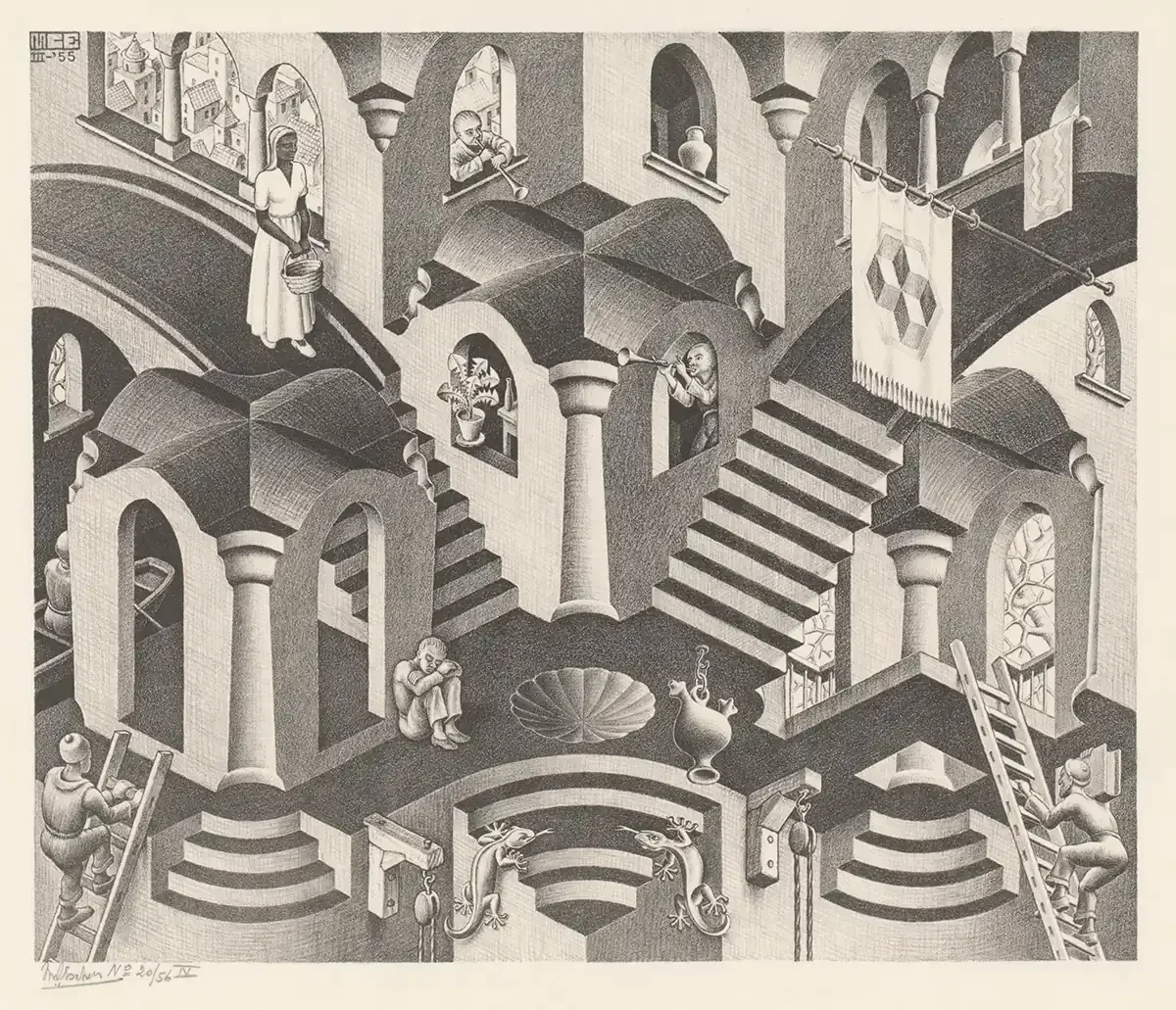
Before continuing, please take a moment to really look at the work.
Quick Facts About Convex and Concave
Year: 1955
Medium: Lithograph
Dimensions: 27.5 × 33.5 cm (10.8 × 13.2 in)
Current location: Escher in The Palace Museum, The Hague, Netherlands
Artistic period: Mature period of impossible constructions
Core concept: Simultaneous interpretation of forms as both convex and concave
How the Illusion in Covex and Concave Works
Convex and Concave exploits the fact that the visual system relies on depth cues such as shading, overlap, and linear perspective to construct three-dimensional interpretations from two-dimensional images. These cues are inherently ambiguous; the same pattern of light and shadow can indicate either a bump or a dent, depending on the assumed direction of lighting.
Escher designed each architectural element to support dual interpretations. A curved surface with shading on the left can be read as a convex form lit from the right or a concave form lit from the left. By maintaining consistent local shading while embedding contradictory global structures, he created a space where both readings are locally plausible but globally incompatible.
The human figures reinforce the impossibility. Characters interact with surfaces as though they were solid floors or walls, but their orientations conflict with one another. A figure standing upright on what appears to be a floor shares the same architectural element with another figure for whom that surface functions as a ceiling. The lithograph does not resolve into a single coherent spatial interpretation: attempting to trace the architecture from one figure to the next reveals the contradictions.
What Are The Themes And Interpretation of Convex and Concave?
Convex and Concave explores the subjectivity of spatial perception and the role of interpretation in constructing reality. The same visual information supports multiple incompatible readings, suggesting that perception is not a passive reception of objective truth but an active process of interpretation. The work demonstrates that ambiguity is not a failure of vision but a fundamental property of how we process spatial information.
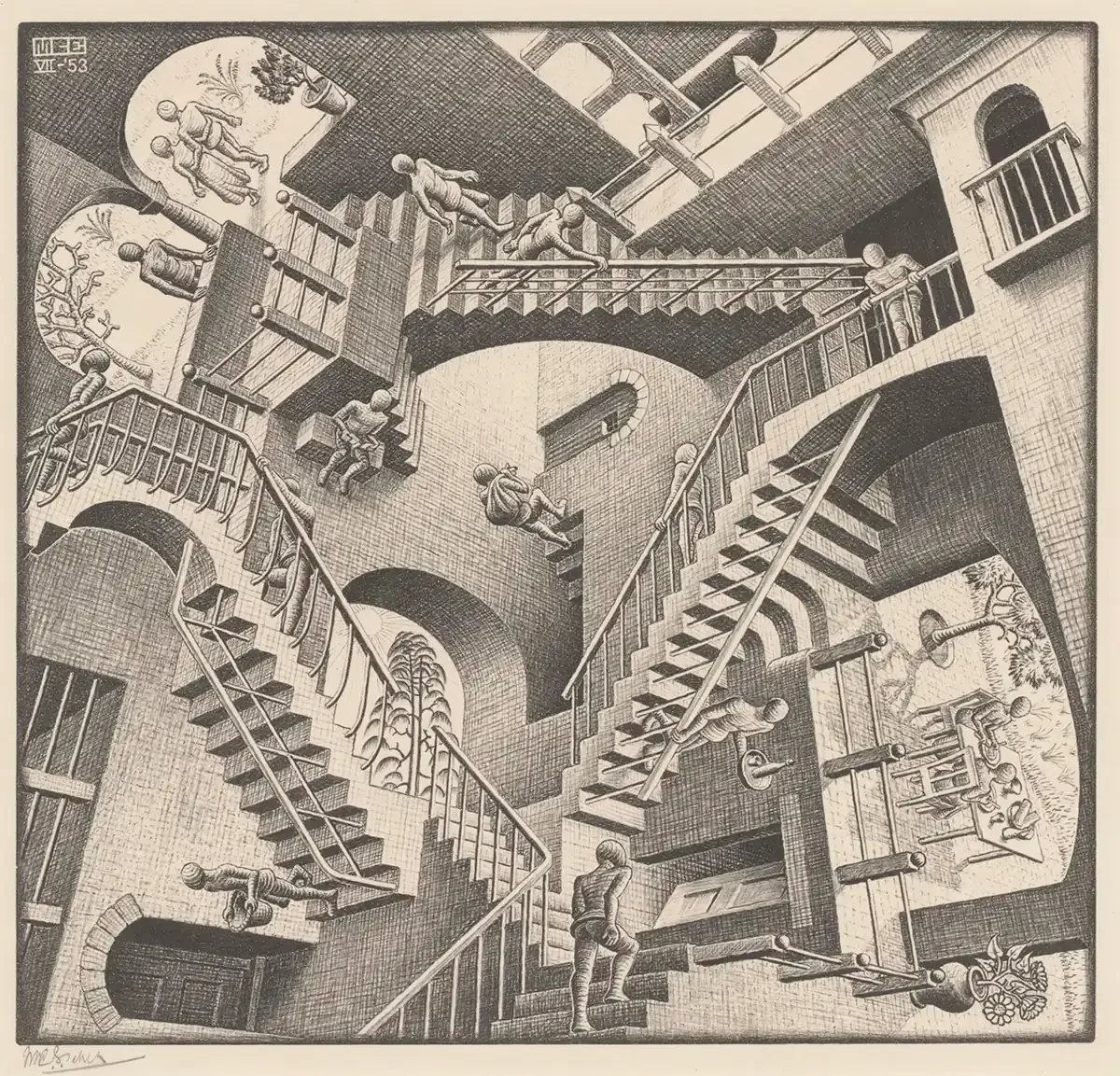
Relativity is another central theme. What appears as up from one vantage point is down from another, and neither perspective is objectively correct. The figures inhabiting the space each experience their orientation as normal, despite occupying contradictory positions relative to one another. This has been interpreted as a commentary on the relativity of viewpoint and the impossibility of a universal frame of reference. This is a recurring feature in Escher works, including in Relativity
The work also engages with the limits of pictorial representation. Two-dimensional images can only suggest three-dimensional space through convention and inference. By manipulating these conventions, Escher reveals their contingency. The architecture appears coherent because viewers bring expectations about how buildings should work, but the image systematically violates those expectations while maintaining the appearance of normality.
Drawing Hands (1953)
Historical Context of Convex and Concave
Escher created Convex and Concave in 1955, during a period of intensive exploration of impossible spaces and ambiguous figures. He had recently completed Relativity (1953), which depicted multiple gravitational orientations within a single structure, and was working toward the self-referential complexity of Print Gallery (1956). Convex and Concave represents a focused investigation of perceptual ambiguity as a structural principle.
The lithograph draws on research in perceptual psychology that was gaining prominence in the 1950s. Psychologists such as Albert Ames had demonstrated through illusions and ambiguous figures that perception involves unconscious inference rather than direct registration of reality. Escher engaged with these ideas visually, creating images that make the interpretive process explicit by offering irreconcilable alternatives.
The architectural vocabulary reflects Escher's long engagement with Mediterranean building styles, particularly Italian and Moorish architecture. The arches, columns, and vaulted spaces echo structures he sketched during his years in Italy and Spain. However, rather than documenting real buildings, he used these familiar forms to construct an impossible hybrid that feels architecturally plausible despite its logical incoherence.
The inclusion of explanatory diagrams at the bottom of the image is unusual for Escher. These simple line drawings serve as a key to understanding the larger composition, showing the basic geometric principles that underlie the architectural elaboration. This pedagogical gesture suggests Escher's awareness that the paradox might not be immediately legible and his desire to guide viewers toward recognizing the dual interpretations.
Why Convex and Concave matters
Convex and Concave is significant as a comprehensive exploration of perceptual ambiguity applied to architectural space. Unlike other works that focused on local impossibilities, a single staircase or water channel, such as Waterfall (1961), this lithograph embeds ambiguity throughout the entire structure. Every element can be read multiple ways, making the space globally unstable rather than containing discrete impossible features.
The work has been influential in psychology and cognitive science as a demonstration of how the brain resolves ambiguous visual information. Researchers have used the lithograph to study bistable perception, the phenomenon where an image spontaneously flips between two interpretations. The architectural context makes these perceptual dynamics more complex than simple figures like the Necker cube, showing how ambiguity operates in rich, detailed environments.
In architecture and design, Convex and Concave has inspired explorations of how spatial perception can be manipulated through deliberate ambiguity. Architects and artists have referenced the work when designing spaces that challenge viewers' assumptions about orientation, surface, and depth. The lithograph demonstrates that architectural coherence is as much a matter of perception as physical structure.
Within Escher's body of work, Convex and Concave represents a mature synthesis of his interests in architecture, geometry, and perceptual paradox. It shows his ability to take a simple principle, the ambiguity of convex and concave forms, and elaborate it into a fully realized, inhabited space. The work bridges his earlier architectural studies and his later, more abstract impossible constructions.

Waterfall (1961)
Frequently Asked Questions About Convex and Concave
What Is the Meaning of Convex and Concave?
Convex and Concave explores the subjectivity of spatial perception and the role of interpretation in constructing reality. The work demonstrates that the same visual information can support multiple incompatible spatial readings, suggesting that perception is an active process rather than passive reception. The lithograph questions whether any single objective view of space exists, showing how architectural forms can function simultaneously as both protruding and receding volumes.
How Did Escher Create Convex and Concave?
Escher designed the lithograph by carefully controlling depth cues such as shading, overlap, and linear perspective to support dual interpretations. Each architectural element was rendered to appear plausible as either a convex or concave form, depending on the viewer's assumed lighting direction and spatial orientation. The lithograph was created by drawing on a prepared stone surface, then transferring the image to paper through printing. The small diagrams at the bottom were included to illustrate the basic geometric principle.
Where Is Convex and Concave Located Today?
The original lithograph is held in the Escher in The Palace Museum in The Hague, Netherlands. The museum maintains the largest institutional collection of Escher's work, including preparatory sketches and finished prints. Limited-edition prints from the original stone and later reproductions are held in museums and private collections worldwide.
Why Is Convex and Concave Important?
Convex and Concave is important as a comprehensive demonstration of perceptual ambiguity in architectural space. It shows how interpretation, rather than objective spatial structure, determines our experience of form. The work has influenced cognitive science research on bistable perception and has been referenced in architecture and design for its exploration of how spatial assumptions can be challenged. It represents a key example of Escher's mature investigation of impossible spaces.
If you like Convex and Concave, you may also like…

Eye (1946)
Reptiles (1943)
Sky and Water I (1938)