Print Gallery by M.C. Escher
Print Gallery is a 1956 lithograph by Dutch artist M.C. Escher. The print depicts a young man viewing a gallery display that contains a harbor town, which in turn contains the gallery where he stands. The work creates a continuous loop where the interior of the building expands to encompass its own exterior, with an unexplained white void at the center where the recursion would theoretically collapse to a point.
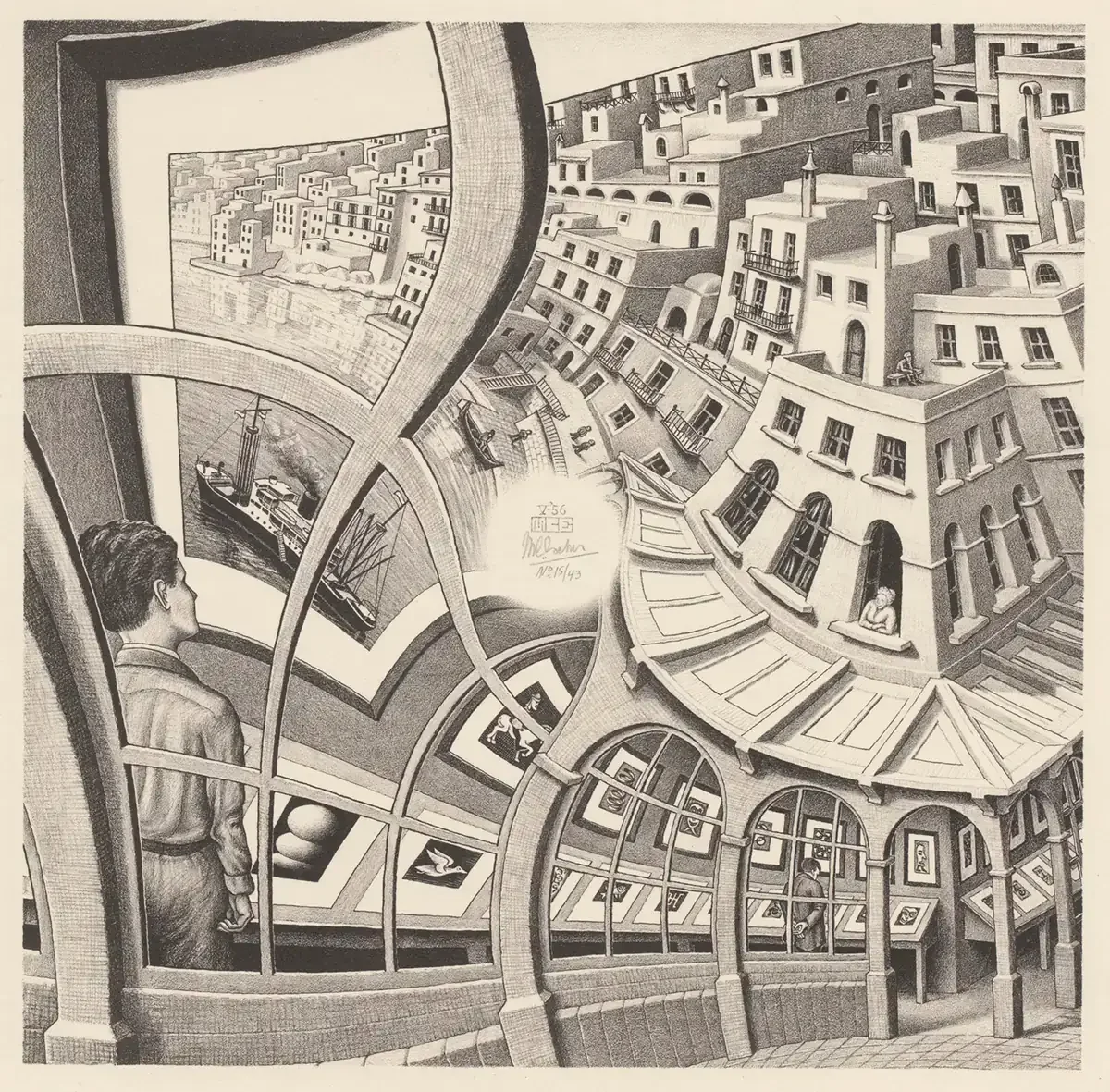
Before continuing, please take a moment to really look at the work.
Quick Facts About Print Gallery
Year: 1956
Medium: Lithograph
Dimensions: 32 × 32 cm (12.6 × 12.6 in)
Current location: Escher in The Palace Museum, The Hague, Netherlands
Artistic period: Mature period of impossible constructions
Core concept: Self-containing recursive space with exponential expansion
What Is Happening in Print Gallery?
The lithograph depicts a young man standing in the lower-right corner of a print gallery, looking at framed prints on the wall. One of the prints depicts a Mediterranean harbor town with buildings, boats, and a waterfront. As the eye follows the print's content upward and to the left, the depicted town expands and curves outward until it becomes the actual architecture surrounding the gallery itself.
The building containing the gallery appears as part of the harbor scene within the print that the man is viewing. The gallery's display windows, visible at the upper left, look out onto the harbor, the same harbor shown in the print. This creates a closed loop: the man views a print of a town that includes the gallery where he stands to view it.
At the center of the composition is a white circular void containing Escher's signature and the date. This blank area corresponds to the mathematical point at which the recursive expansion would converge. The surrounding imagery curves and distorts as it approaches this void, with buildings and architectural elements stretching and warping toward the center.
How Print Gallery Works
Print Gallery is constructed using a mathematical technique called exponential expansion. Escher divided the image into a grid and applied a transformation that compresses scale toward the center while expanding it toward the edges. The result is that the same space appears at multiple scales simultaneously; what begins as a small framed print becomes, through continuous expansion, the full-scale environment containing the gallery.
The recursion is theoretically infinite. The print contains the town, which contains the gallery, which contains the print, which contains the town, and so on. Each iteration would be smaller than the last, converging toward the center point. In principle, this point should contain the entire image compressed to an infinitesimal size. Escher left this area blank rather than attempting to resolve the mathematical singularity.
Mathematician Hendrik Lenstra later analyzed the structure and demonstrated that the blank center could be filled with a greatly reduced version of the entire image, proving that the recursion is mathematically consistent except at the central point. The distortion follows a logarithmic spiral pattern, with elements stretching proportionally as they curve around the void. This gives the architecture a warped, dreamlike quality while maintaining recognizable forms. The recursive self-reference shares conceptual ground with Drawing Hands (1948), where two hands draw each other into existence, though Print Gallery embeds the recursion within continuous spatial transformation rather than discrete objects.

Drawing Hands (1948)
What Are The Themes And Interpretation of Print Gallery?
Print Gallery explores self-reference and the paradox of containment. The work literalizes the concept of a set containing itself, a logical impossibility that Escher renders visually plausible through continuous transformation. The young man observes a scene that contains him, creating an observer paradox where no external vantage point exists.
Infinity is another central theme. The recursive loop has no beginning or end; every element is simultaneously inside and outside the system. The white void at the center represents the point where this infinite regression should collapse, a visual acknowledgment that the paradox cannot be fully resolved. The void functions as both absence and origin, the missing piece that makes the whole possible.
The work also engages questions of representation and reality. The print within the print is indistinguishable from the gallery's actual architecture, collapsing the distinction between depiction and depicted space. This has been interpreted as commentary on how images shape perception, with the boundary between the viewer and the viewed becoming unstable. The young man exists in the world he observes, unable to step outside the frame.
Historical Context of Hand with Reflecting Sphere
Escher created Print Gallery in 1956, during a period of intense engagement with mathematical and logical paradoxes. He had been corresponding with mathematicians and reading about topics such as topology, non-Euclidean geometry, and the work of logician Kurt Gödel on self-referential systems. Print Gallery represents an attempt to visualize these abstract concepts through architectural space.
The lithograph follows several other works addressing impossible spaces and recursive structures, including Relativity (1953) and Bond of Union (1956). However, Print Gallery is unique in Escher's catalog for its use of exponential distortion to create continuous self-containment. Earlier works used local impossibilities, staircases that loop, water that flows uphill, but Print Gallery constructs a globally paradoxical space where every part connects to every other part.
The choice of a gallery setting may reference Escher's own relationship to his work. The young viewer could be interpreted as a stand-in for the artist himself, observing his creation while being embedded within it. The Mediterranean architecture reflects locations Escher visited during his years in Italy, particularly towns along the Amalfi Coast. The harbor and boats recall the coastal landscapes he drew extensively before shifting focus to mathematical themes.

Bond of Union (1956)
Why This Work Matters
Print Gallery is widely regarded as one of Escher's most sophisticated achievements in visualizing mathematical concepts. The work's combination of recursive structure, exponential distortion, and self-containment pushed beyond earlier impossible constructions toward a more complex engagement with spatial paradox. Its influence extends into computer science, where similar recursive structures appear in discussions of self-referential systems and fractal geometry.
Within popular culture, Print Gallery has become an iconic image associated with concepts of infinity, recursion, and meta-awareness. The blank center has generated particular fascination, interpreted variously as a necessary incompleteness, a deliberate acknowledgment of limitation, or a space for viewer projection. The mystery of what should appear there continues to invite interpretation. It is one of the most recognizable works, alongside Relativity (1953), Sky and Water I (1938), Waterfall (1961) and Ascending and Descending (1960).
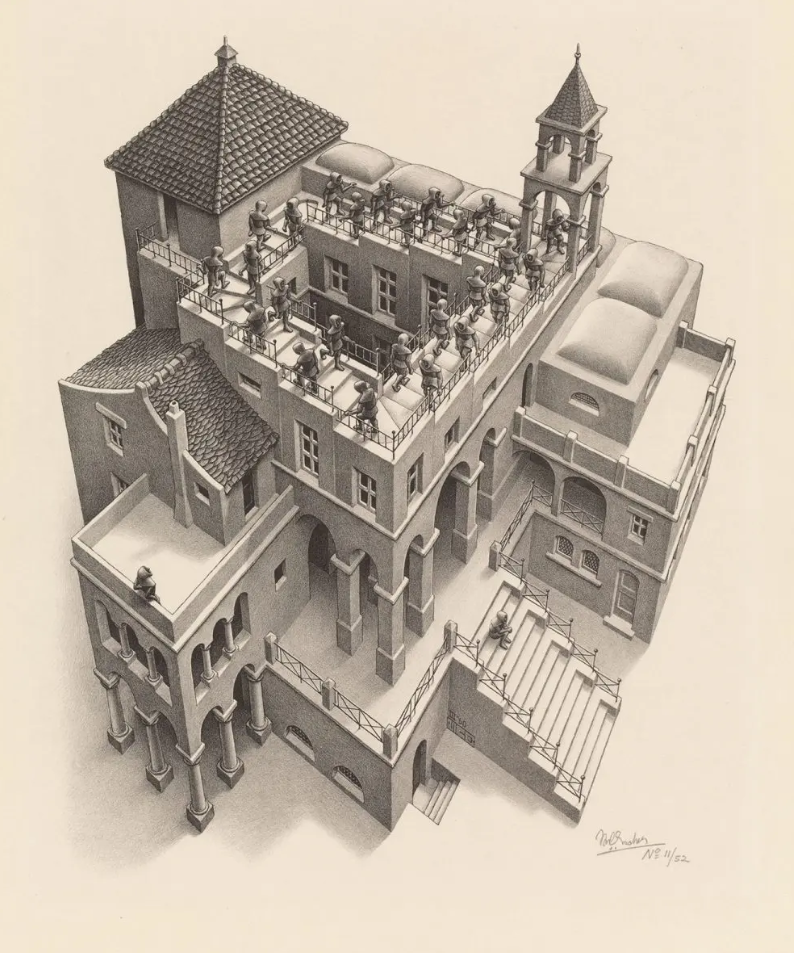
Ascending and Descending (1960)
Frequently Asked Questions About Print Gallery
What Is the Meaning of Print Gallery?
Print Gallery is most commonly interpreted as an exploration of self-reference and infinite recursion. The work depicts a scene that contains itself, creating a paradoxical loop where inside and outside, observer and observed, become indistinguishable. The blank center represents the mathematical singularity where the recursion would theoretically collapse. The work questions the stability of boundaries between representation and reality.
How Did Escher Create Print Gallery?
Escher used a mathematical technique involving exponential expansion and logarithmic spirals. He applied a transformation that compressed the image toward the center while expanding it toward the edges, allowing the same space to appear at multiple scales. The lithograph was created by drawing on a prepared stone, then transferring the image to paper through printing. The blank center was left incomplete rather than attempting to resolve the mathematical singularity.
Where Is Print Gallery Located Today?
The original lithograph is held in the Escher in The Palace Museum in The Hague, Netherlands. The museum maintains the most comprehensive collection of Escher's prints and preparatory studies. In 2003, mathematicians created a digital completion showing what would theoretically appear in the blank center, though this remains a mathematical exercise rather than Escher's intended resolution.
Why Is Print Gallery Important?
Print Gallery is significant as a visual representation of self-referential systems and infinite recursion. It demonstrates how paradoxical structures can be rendered coherently except at a singular exception point. The work has influenced computer science, mathematics, and philosophy, serving as a reference point for discussions of strange loops, Gödelian incompleteness, and the limits of representation. It represents Escher's most mathematically sophisticated engagement with spatial paradox.
If you like Hand with Reflecting Sphere, you may also like…

Eye (1946)
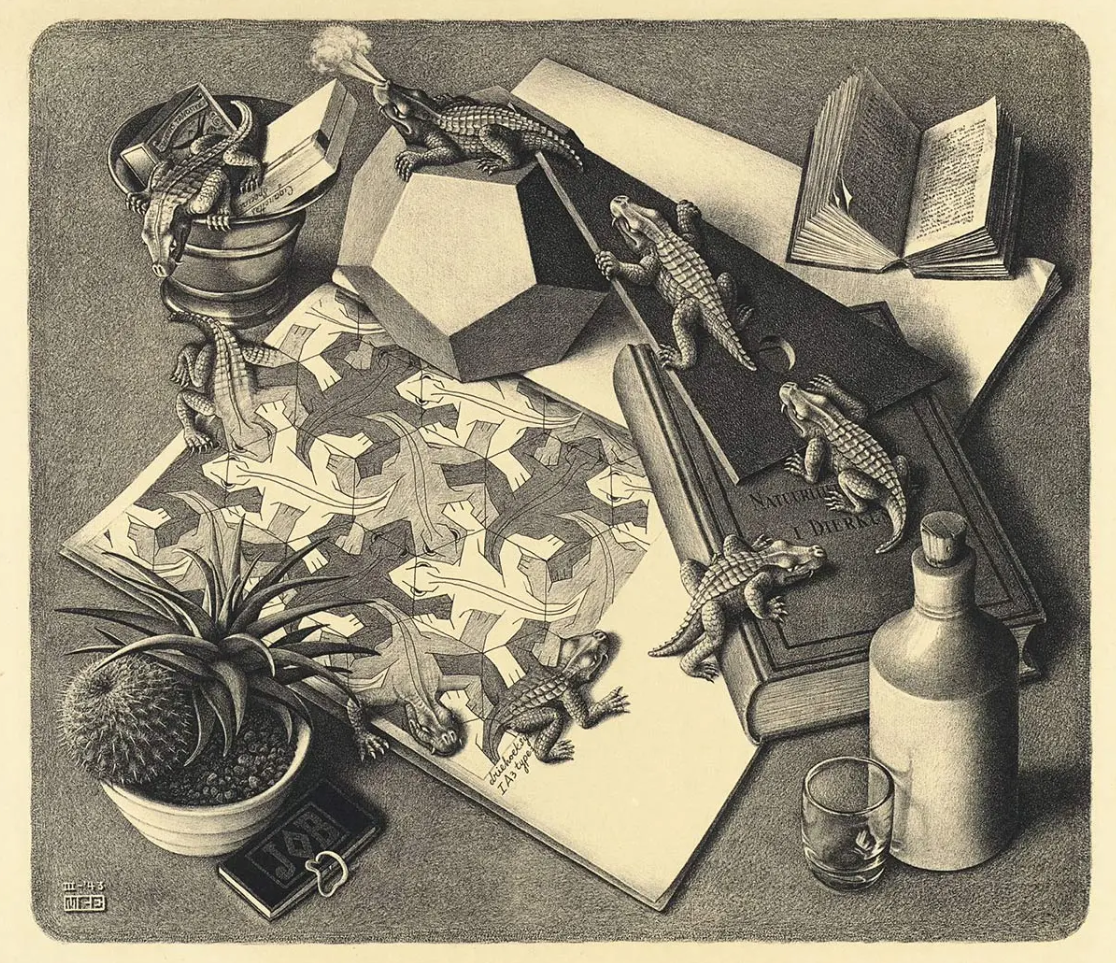
Reptiles (1943)
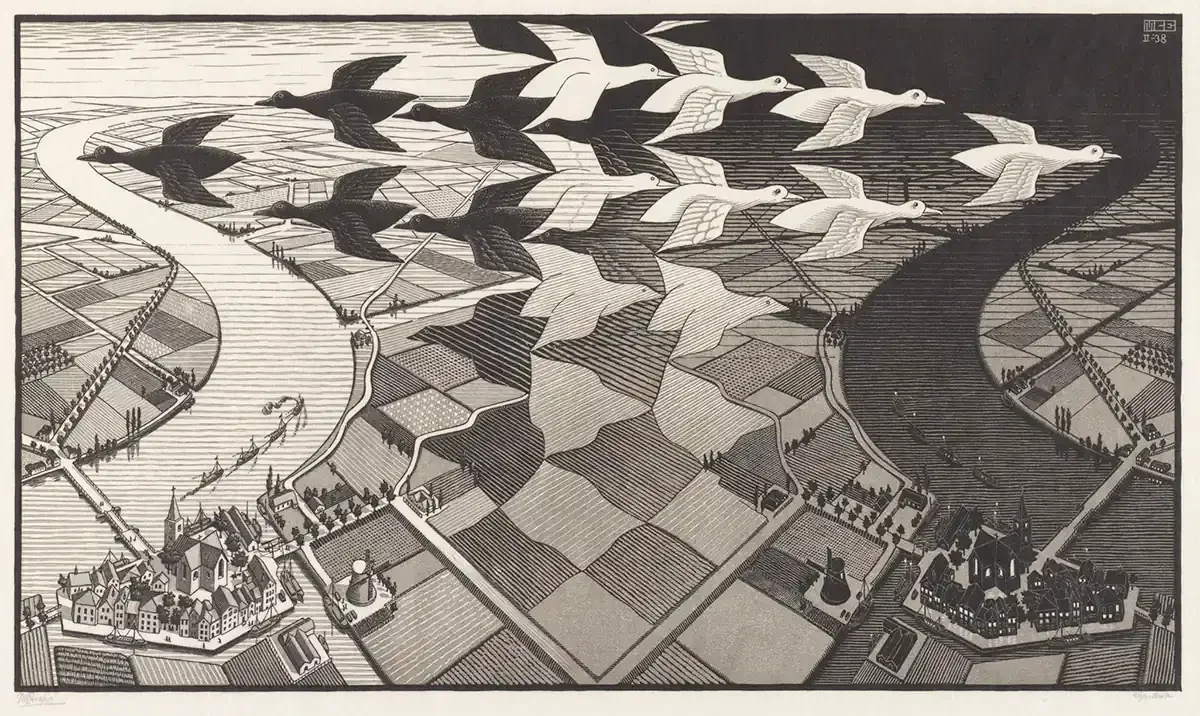
Day and Night (1938)