Day and Night by M.C. Escher
Day and Night is a 1938 woodcut by Dutch artist M.C. Escher. The print depicts two flocks of birds, white birds flying over a nocturnal landscape on the right, and black birds flying over a daylit landscape on the left, emerging from an interlocking tessellation at the center. The work demonstrates a gradual transformation from geometric pattern to recognizable forms while simultaneously contrasting day and night.
Before continuing, please take a moment to really look at the work.
Quick Facts About Day and Night
Year: 1938
Medium: Woodcut printed from two blocks
Dimensions: 39.1 × 67.7 cm (15.4 × 26.7 in)
Current location: Escher in The Palace Museum, The Hague, Netherlands
Artistic period: Early tessellation period
Core concept: Metamorphosis from tessellation to figurative imagery with dual opposites
How Day and Night Works
Day and Night uses principles of figure-ground reversal and tessellation. At the center of the image, the white and black shapes fit together without gaps or overlaps, functioning as both positive and negative space simultaneously. The white shapes can be read as fields against a black background, or the black shapes can be read as fields against a white background. Neither reading is more correct than the other. This ambiguity appears in other Escher works such as Sky and Water I (1938), where birds and fish occupy the same visual field, and in the architectural paradoxes of Relativity (1953), where multiple interpretations of space coexist.
Escher engineered the metamorphosis by designing shapes that serve dual functions. The agricultural field patterns at the bottom are already suggestive of bird forms, elongated diamonds that hint at wings and bodies. As the shapes ascend, Escher gradually refined their contours to make the avian features explicit. The transformation is smooth rather than abrupt, with no single point where the shapes become definitively birds rather than fields.
The color reversal, white birds over darkness, black birds over light, creates a visual balance and emphasizes the duality theme. Each side provides the contrasting background necessary to make the opposite-colored birds visible. Without this reversal, the birds would blend into their respective skies. The symmetry extends to the landscapes below, which mirror each other in composition but oppose each other in illumination.
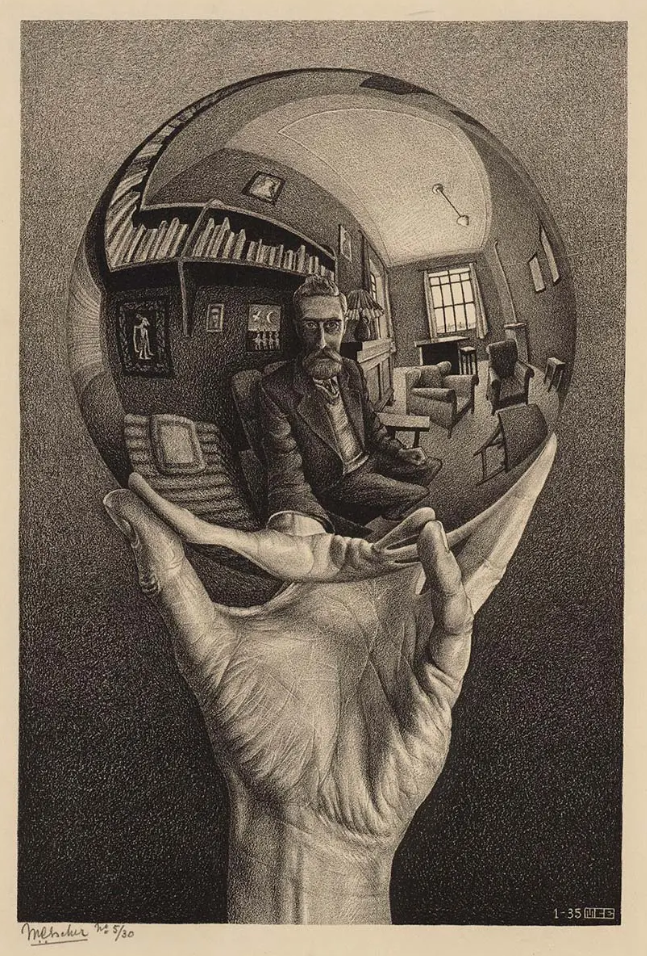
What Are The Themes And Interpretation of Hand with Reflecting Sphere?
Day and Night explores duality and the interdependence of opposites. Day requires night to define it, light requires darkness, and positive space requires negative space. The tessellation at the center embodies this relationship — the white and black shapes create each other through their boundaries. Neither can exist without the other, and both are necessary to complete the pattern. This exploration of duality would appear in different forms in works like Hand with Reflecting Sphere (1935), where the artist's reflection remains centered in a mirrored sphere, and Relativity (1953), where multiple gravitational orientations coexist within a single architecture.
Metamorphosis is another central theme. The work demonstrates transformation as a gradual process rather than a sudden shift. The fields become birds through incremental changes, showing that distinct categories, geometric versus organic, abstract versus representational, can be connected by intermediate forms. This anticipates Escher's later Metamorphosis II (1940) and Metamorphosis III (1967-1968), which extend similar transformations across even longer sequences.
The Dutch landscape carries symbolic and personal significance. The polder landscape represents Escher's homeland, which he was viewing from a distance after years abroad. The mirrored towns and geometric fields evoke the highly ordered, human-modified terrain of the Netherlands. By showing this landscape both in day and night, Escher suggests the cyclical nature of time and the coexistence of opposites within a single place.
Hand with Reflecting Sphere (1935)
Historical Context of Day and Night
Escher created Day and Night in 1938 while living in Belgium, shortly after leaving Italy due to the rise of fascism. The work marks an important development in his exploration of tessellation, a technique he had begun studying seriously in the mid-1930s after encountering Moorish geometric patterns at the Alhambra in Spain. Day and Night represents one of his first successful integrations of tessellation with naturalistic landscape imagery.
The print was created the same year as Sky and Water I (1938), another woodcut exploring figure-ground reversal through birds and fish. Both works demonstrate Escher's growing confidence in combining tessellation with representational content. Where Sky and Water I focuses on the vertical transition between two elements, Day and Night adds horizontal symmetry and the complication of opposing landscapes. Together, these 1938 prints established the formal vocabulary Escher would develop throughout his career.
The print belongs to the early phase of what would become Escher's signature style. Prior to the late 1930s, his work consisted primarily of landscapes, architectural studies, and naturalistic prints. Day and Night demonstrates the shift toward mathematical and conceptual concerns that would define his mature career. It combines his earlier skills in landscape observation with his growing interest in pattern and transformation.
The woodcut technique required Escher to carve two separate blocks, one for black ink and one for white, and print them in precise registration. This technical process reinforced the conceptual duality of the image, as each color was literally produced by a separate physical object. The method also required Escher to plan the entire composition in advance, since corrections to carved wood blocks are difficult.
Day and Night was well received and became one of Escher's most reproduced images. Its clarity and visual impact made it accessible to viewers unfamiliar with mathematical art, while its structural sophistication appealed to those interested in pattern and symmetry. The work helped establish Escher's reputation beyond the Netherlands.
Frequently Asked Questions About Day and Night
What Is the Meaning of Day and Night?
Day and Night is most commonly interpreted as an exploration of duality and the interdependence of opposites. The white and black birds, the day and night landscapes, and the figure-ground reversal in the tessellation all emphasize how opposing elements define and depend on each other. The gradual transformation from fields to birds suggests that distinct categories exist on a continuum rather than as absolute divisions.
How Did Escher Create Day and Night?
Escher used a two-block woodcut technique, carving one block to print black ink and another to print white ink on a gray background. He designed the composition to allow the shapes at the center to function as both positive and negative space simultaneously. The metamorphosis from geometric fields to birds was planned by gradually modifying the contours of the tessellated shapes as they moved upward through the image.
Where Is Day and Night Located Today?
The original woodcut is held in the Escher in The Palace Museum in The Hague, Netherlands. The museum maintains the largest institutional collection of Escher's work, including preparatory drawings and the original carved woodblocks. Prints from the original blocks and later reproductions are held in museums and collections worldwide.
Why Is Day and Night Important?
Day and Night is important as a landmark work in Escher's development of tessellation-based imagery. It successfully integrates mathematical pattern with representational content and narrative themes. The work's visual clarity and conceptual depth made it accessible to wide audiences while demonstrating sophisticated structural principles. It influenced subsequent developments in graphic design, illustration, and mathematical art.