Up and Down by M.C. Escher
Up and Down is a 1947 lithograph by Dutch artist M.C. Escher. The print depicts an architectural structure with two opposing gravitational orientations contained within a single continuous space. Human figures occupy the building in two groups, one group walking normally while the other appears inverted, each experiencing their orientation as floor-and-ceiling while sharing the same architectural elements.
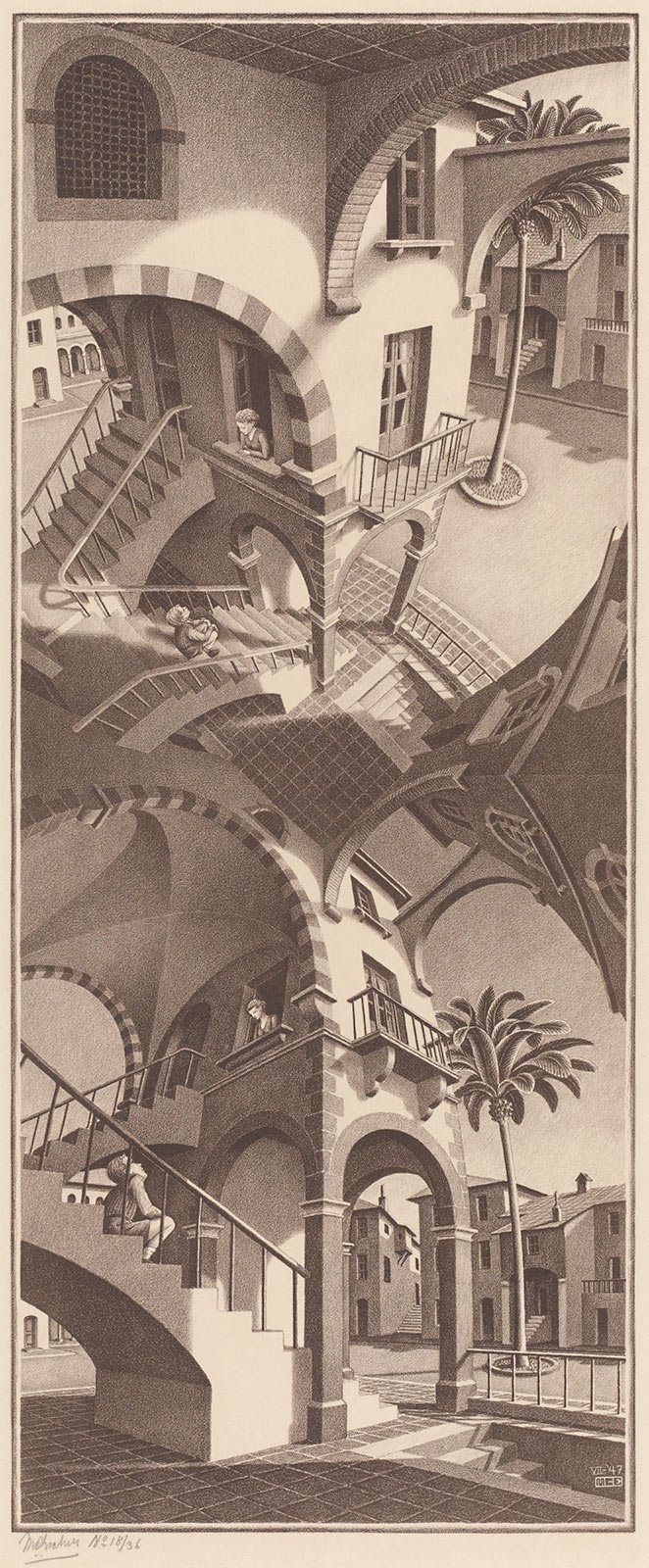
Before continuing, please take a moment to really look at the work.
Quick Facts About Up and Down
Year: 1947
Medium: Lithograph
Dimensions: 50.5 × 20.5 cm (19.9 × 8.1 in)
Current location: Escher in The Palace Museum, The Hague, Netherlands
Artistic period: Early exploration of impossible constructions
Core concept: Dual gravitational fields sharing unified architecture
What Is Happening in Up and Down?
The lithograph shows a tall, narrow interior space filled with staircases, arches, columns, and tiled floors. Human figures occupy various positions throughout the structure — some walking on floors, others climbing stairs, and several standing in doorways or archways. The space appears to be a coherent multi-story building with classical architectural details.
The central paradox emerges when examining the figures' orientations. The lower half of the image shows figures standing and walking in normal upright positions. The upper half shows figures in inverted positions, as though the ceiling has become their floor. A single architectural space serves two opposing gravitational fields simultaneously, with elements functioning as floor for one group and ceiling for another.
The transition between the two orientations occurs at the center of the image, where the architectural elements begin to serve dual functions. Staircases that one group climbs upward become staircases another group descends from the opposite direction. Arched doorways frame passages for both orientations. The building's symmetry allows it to appear structurally sound from either perspective, but the two perspectives cannot coexist in three-dimensional space.
How Up and Down Works
Up and Down uses architectural symmetry to create a structure that reads coherently from two opposing viewpoints. Escher designed the building so that the upper and lower halves mirror each other, with the central axis functioning as a line of reflection. Elements in the bottom half have corresponding elements in the top half positioned at 180-degree rotation.
The impossibility lies in the continuity between the two halves. In a real building, the upper and lower sections would be separate spaces with their own distinct orientations. In Escher's lithograph, they share the same architectural elements. Columns that support the floor of the upper section are the same columns that support the ceiling of the lower section, even though the floor and ceiling point in opposite directions.
Escher used consistent perspective and lighting within each half to make the local regions appear convincing. The lower figures cast shadows downward, the upper figures cast shadows in what appears to them as downward but appears to a viewer as upward. The stone textures, tiled patterns, and architectural details are rendered with precision, reinforcing the illusion that this is a functional building rather than an impossible construction.
The work represents an early exploration of the dual-gravity concept Escher would develop more fully in Relativity (1953), which extends the principle to three perpendicular orientations rather than two opposing ones. The narrow vertical format emphasizes the top-to-bottom axis and makes the inverted symmetry visually apparent. This compositional choice differs from the more complex spatial arrangements in later works like Convex and Concave (1955), where ambiguity pervades the entire structure rather than dividing along a clear axis.
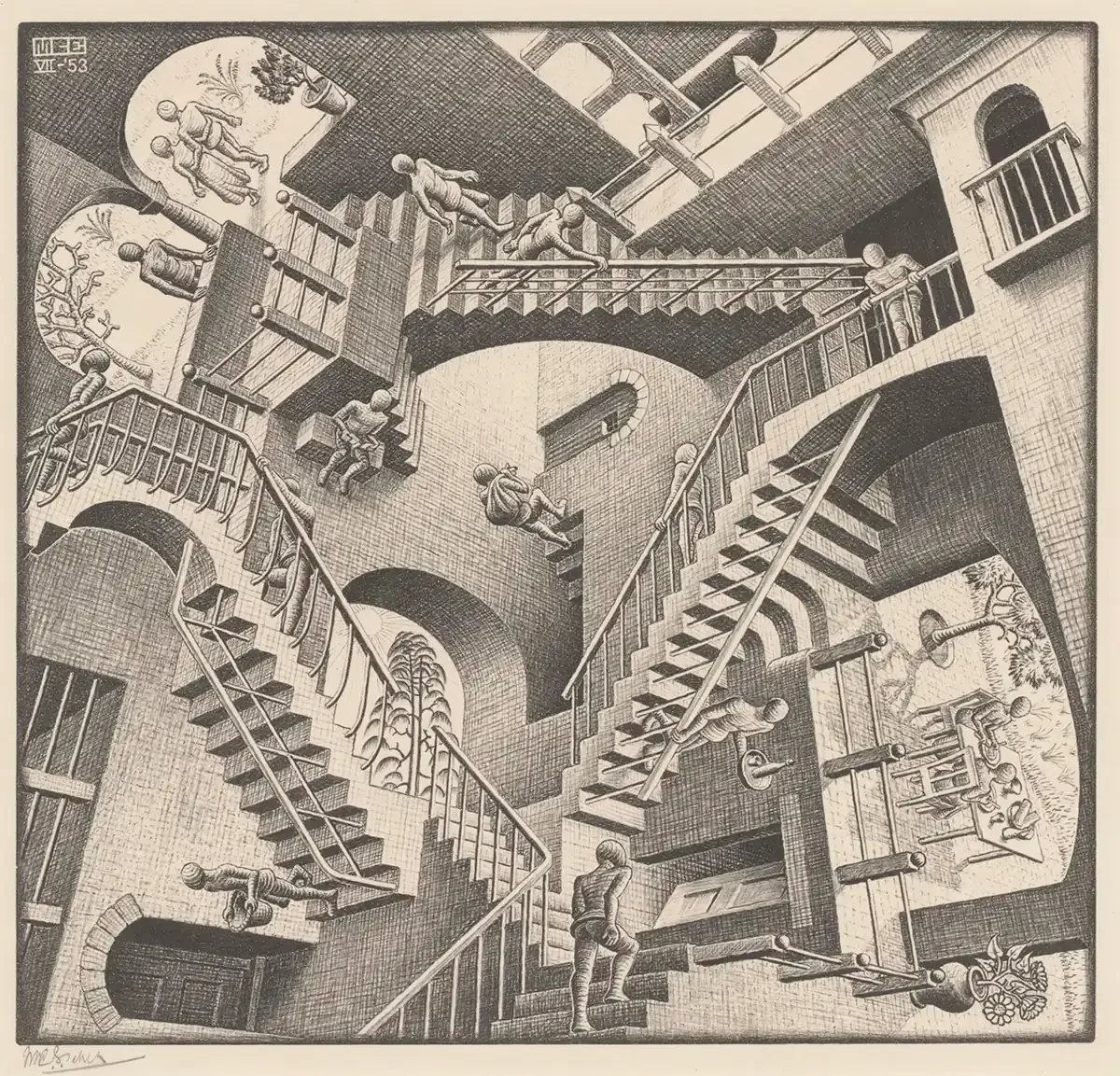
Relativity (1953)
What Are The Themes And Interpretation of Up and Down?
Up and Down explores the relativity of spatial orientation and the absence of absolute direction. What constitutes "up" depends entirely on frame of reference. Each group of figures experiences their orientation as normal — they walk on floors, climb stairs ascending upward, and occupy rooms with ceilings above them. From an external viewpoint, one group must be inverted, but within the logic of the image, neither orientation is more correct than the other.
The work engages with symmetry and duality, showing how the same structure can serve opposing functions simultaneously. The architectural elements are perfectly mirrored, creating a visual balance that reinforces the conceptual balance between the two gravitational fields. This exploration of paired opposites connects thematically to Day and Night (1938), where white and black birds fly over opposing landscapes, and to the figure-ground reversals in Sky and Water I (1938), where birds and fish occupy the same visual space through tessellation.
Isolation is another implicit theme. Despite occupying the same building, the two groups of figures exist in mutually exclusive worlds. They share architectural space but cannot interact. A figure from one orientation would experience the other group's floor as a ceiling and vice versa. This separation within unity appears in different forms throughout Escher's work, including the disconnected gravitational systems in Relativity and the incompatible architectural readings in Belvedere (1958).
The presence of recognizable human figures and classical architecture grounds the impossibility in familiar contexts. Unlike abstract geometric puzzles, Up and Down presents an inhabited space where ordinary activities — walking, climbing stairs, moving through doorways — occur within an extraordinary structural paradox. This domestication of impossibility would become a signature element of Escher's mature work.
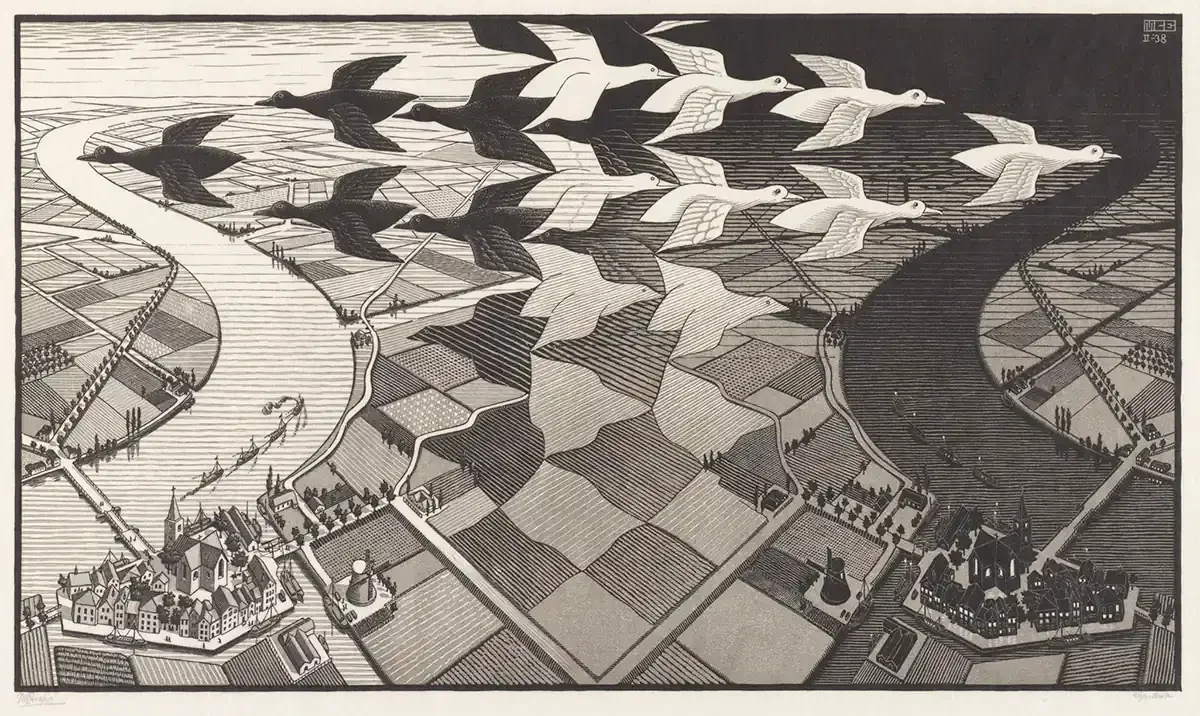
Day and Night (1938)
Historical Context of Hand with Up and Down
Escher created Up and Down in 1947, during a transitional period in his artistic development. He had largely moved away from landscape and naturalistic subjects and was beginning sustained exploration of mathematical and perceptual paradoxes. The lithograph represents one of his first successful attempts to depict dual gravity fields, predating the more complex three-way orientation in Relativity by six years.
The post-World War II period saw renewed interest in questions of perspective, relativity, and the nature of space. Einstein's theories had entered popular consciousness, and artists across Europe were exploring how visual representation could challenge conventional assumptions about reality. Escher's engagement with these ideas was intuitive and visual rather than mathematically rigorous, but it resonated with broader cultural currents.
The architectural vocabulary draws on Escher's extensive study of Mediterranean and Renaissance building styles during his years in Italy. The arches, columns, tiled floors, and stone construction echo structures he sketched throughout the 1920s and 1930s. By the late 1940s, he was using this architectural language not to document real buildings but to construct impossible ones that felt familiar despite their logical incoherence.
The narrow vertical format of Up and Down is unusual for Escher's architectural works. The elongated composition emphasizes the vertical axis and makes the symmetrical inversion immediately readable. This choice of format may have been influenced by medieval altar panels or decorative pilasters, though Escher adapted it to serve his exploration of spatial paradox rather than religious iconography.
Why Up and Down Matters
Up and Down is significant as an early example of Escher's mature engagement with impossible architecture. While he had experimented with optical illusions and ambiguous figures before, this lithograph represents a systematic application of dual gravity fields to a fully realized architectural environment. The work established formal and conceptual strategies he would refine in later prints.
The lithograph demonstrates how symmetry can be used to create structural paradoxes. By mirroring the architecture along the central axis, Escher made the dual orientation visually coherent while remaining spatially impossible. This technique anticipates the more complex symmetries in works like Print Gallery (1956), where exponential expansion creates recursive self-containment, and the figure-ground reversals in his tessellation prints.
Within architectural and design contexts, Up and Down has influenced thinking about how spatial perception depends on orientation cues. The work shows that familiar architectural elements can be reconfigured to produce radically different spatial experiences. Architects and artists have referenced the print when designing installations that manipulate gravity perception or challenge conventional building logic.
Within Escher's body of work, Up and Down represents a bridge between his earlier naturalistic period and his later focus on mathematical impossibility. It combines detailed architectural rendering with conceptual paradox, showing his ability to integrate technical precision with spatial experimentation. The work's clarity and directness make the dual-gravity concept immediately accessible, unlike some of his more complex later constructions, where the impossibility requires careful study to recognize. This accessibility helped establish Escher's reputation and demonstrated that impossible spaces could be visually convincing and conceptually rigorous simultaneously.
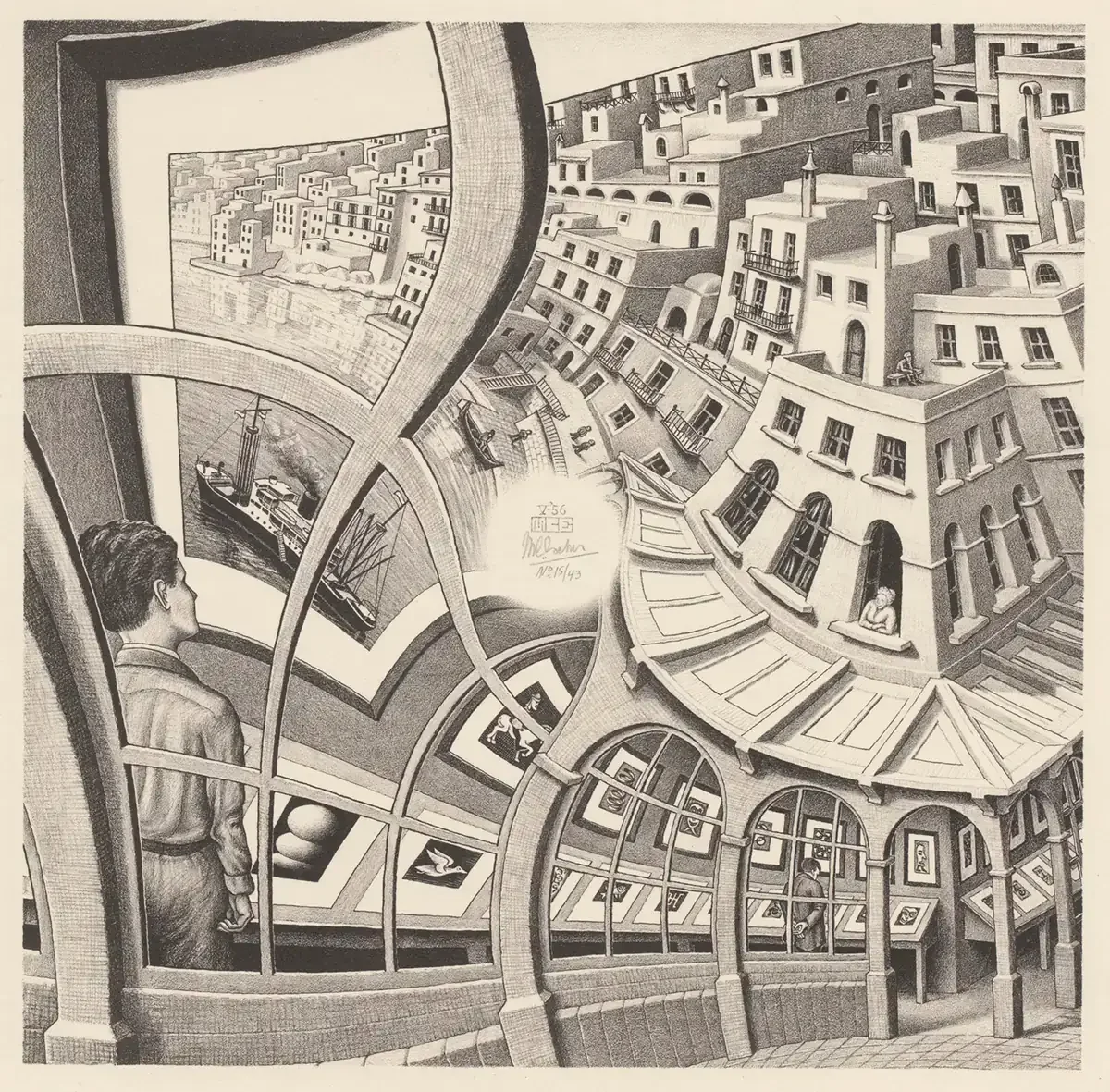
Print Gallery (1956)
Frequently Asked Questions About Up and Down
What Is the Meaning of Up and Down?
Up and Down explores the relativity of spatial orientation and the absence of absolute direction in space. The work demonstrates that "up" and "down" are frame-dependent rather than absolute properties. Each group of figures experiences their orientation as normal, but these experiences are mutually incompatible. The lithograph questions fundamental assumptions about gravity and architectural orientation.
How Did Escher Create Up and Down?
Escher designed the lithograph using architectural symmetry, mirroring the structure along a central horizontal axis so that the upper and lower halves could serve as floor and ceiling simultaneously. He used consistent perspective and lighting within each half while connecting them through shared architectural elements. The lithograph was created by drawing on a prepared stone surface, then transferring the image to paper through printing.
Where Is Up and Down Located Today?
The original lithograph is held in the Escher in The Palace Museum in The Hague, Netherlands. The museum maintains the largest institutional collection of Escher's work, including prints, drawings, and preparatory materials. Limited-edition prints from the original stone are held in various museums and private collections worldwide.
Why Is Up and Down Important?
Up and Down is important as an early successful exploration of dual gravitational fields in architecture. It established formal strategies Escher would develop in later works like Relativity and demonstrated how symmetry can create structural paradoxes. The work shows that familiar architectural elements can be recombined to challenge fundamental spatial assumptions while remaining visually coherent.
If you like Hand with Reflecting Sphere, you may also like…

Eye (1946)
Reptiles (1943)
Three Worlds (1955)